
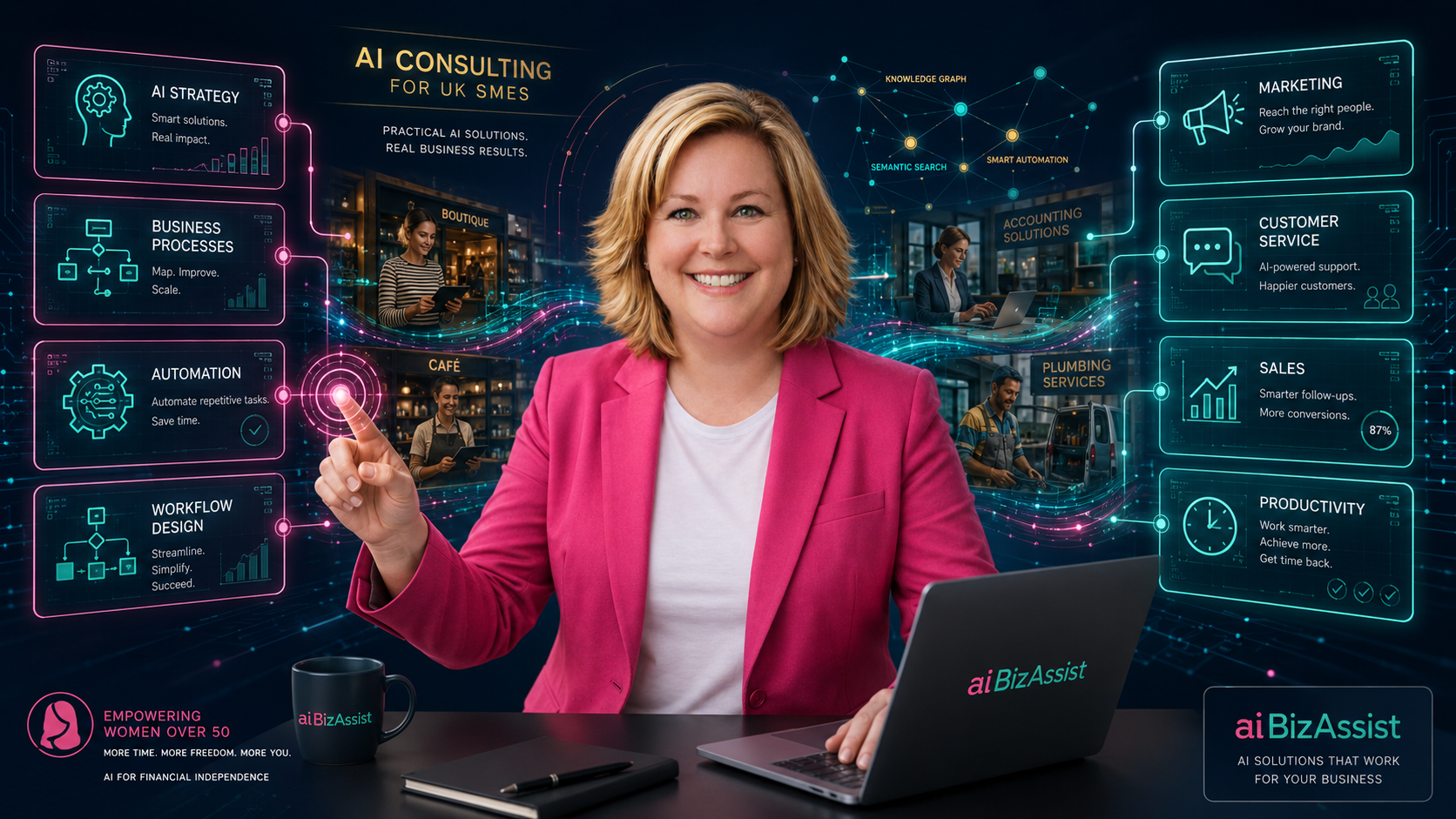
What Does an AI Consultant Do for a Small Business? A Plain-English Guide for UK SMEs
Reviewed by Debbie Wallace, Founder of aiBizAssist
Most UK small business owners asking this question have already been burned once by a tool that didn't deliver, a webinar that promised everything, or a quote from a consultant that started at 30,000 pounds and ended with a PDF. This is the honest answer.
An AI consultant is not a tech person. They are a business problems person.
The confusion happens because AI sounds technical. But the work of a good AI consultant is almost entirely operational. They sit with you in your business, map how work actually flows, and find the places where time is being lost, decisions are being delayed, or errors are creeping in. Then they help you fix those specific things with AI or without it, whichever is actually appropriate.
I come from 25 years in operations, supply chain and procurement. Not software. Not data science. That matters, because the problems AI solves in a small business are almost never technical problems. They are process problems, people problems, and clarity problems. I recognise them immediately because I have lived them.
What an AI consultant actually does, in plain terms
1. Maps your real workflows before touching any technology
The first thing I do with any client is spend time understanding how work gets done today and not how the organisational chart says it gets done. Who actually sends the Monday morning report? Where does a customer enquiry sit for three days because nobody is sure whose job it is? Which supplier invoice gets keyed into three different systems by three different people?
These are the friction points AI can address. You cannot find them by looking at a software demo. You find them by talking to the people doing the work.
2. Identifies where AI will deliver genuine return and where it won't
A good consultant tells you what not to do as clearly as what to do. Not every process should be automated. Some things are too complex, too relationship-dependent, or too low-volume to justify the effort. Knowing the difference saves you money.
In my experience, the highest-value starting points for UK SMEs are usually: responding to routine customer enquiries, generating first drafts of documents and reports, summarising meeting notes and action points, and processing supplier information. These are not glamorous. They are also not 50,000 pound projects. They are things you can start doing next month.
3. Recommends tools that fit your actual budget and team
Most small businesses do not need custom AI software. They need to use the tools that already exist such as ChatGPT, Claude, Gemini, Canva AI - properly and consistently. The gap between a team that uses AI randomly and a team that uses it systematically is enormous and closing that gap is mostly a training and process question, not a technology question.
4. Trains your team so AI sticks
Implementation without training is just expensive shelfware. Every engagement I run includes hands-on training for the actual people who will use the tools. Not a one-hour lunch-and-learn. Real working sessions where your team builds prompts for their specific tasks, asks the awkward questions, and leaves knowing exactly what to do on Monday morning.
5. Gives you a roadmap, not a dependency
A good AI consultant should be reducing your need for them over time, not increasing it. My goal is always to leave you with a clear prioritised roadmap, a trained team, and the confidence to keep going without me holding your hand.
What an AI consultant is not
An AI consultant is not an IT consultant. IT consultants fix systems and manage infrastructure. That is a different and important job. AI consultants focus on operations, workflows and people and on how work gets done and how to make it better.
An AI consultant is also not a software salesperson. If your consultant is steering every conversation towards a specific product they happen to sell, that is a conflict of interest worth naming.
How much does an AI consultant cost for a small business?
For a UK SME, a practical AI engagement does not need to cost 30,000 pounds. At aiBizAssist, I work with fixed-price services designed for small business budgets: a structured AI Readiness Assessment that gives you a clear roadmap, and hands-on workshop training that gets your team using AI confidently within a day.
The starting point is always a free discovery call which takes 15-30 minutes, so I can understand what you are hoping to achieve, what your pain points are at a high level and whether we are a good fit to work together. Either way, you leave with a clear sense of what the right next step is for your specific business.
What to look out for before you hire an AI consultant
The biggest red flag is a consultant who leads with tools before they understand your workflows. If someone is recommending software in the first conversation without first asking how your business actually operates, that is a warning sign, not a strategy. You risk spending money building processes around a tool that was never the right fit to begin with.
AI should enhance workflows that already exist, not replace the thinking that should happen before any technology is introduced.
Before you commit to anyone, you should expect three things: you are going to get a clear roadmap, a realistic implementation plan and timeline, and an honest picture of what success actually looks like in your specific business. Not a generic outcome. Yours.
Debbie Wallace is the founder of aiBizAssist and an AI Business Consultant and Trainer with 25+ years of experience in operations, supply chain, procurement and e-commerce. She works with UK SME owners and their teams to adopt AI practically and safely. Book a free discovery call.
Frequently Asked Questions
Book Your Free Discovery Call
Let's talk about what your business needs and whether working with an AI consultant is the right next step.