
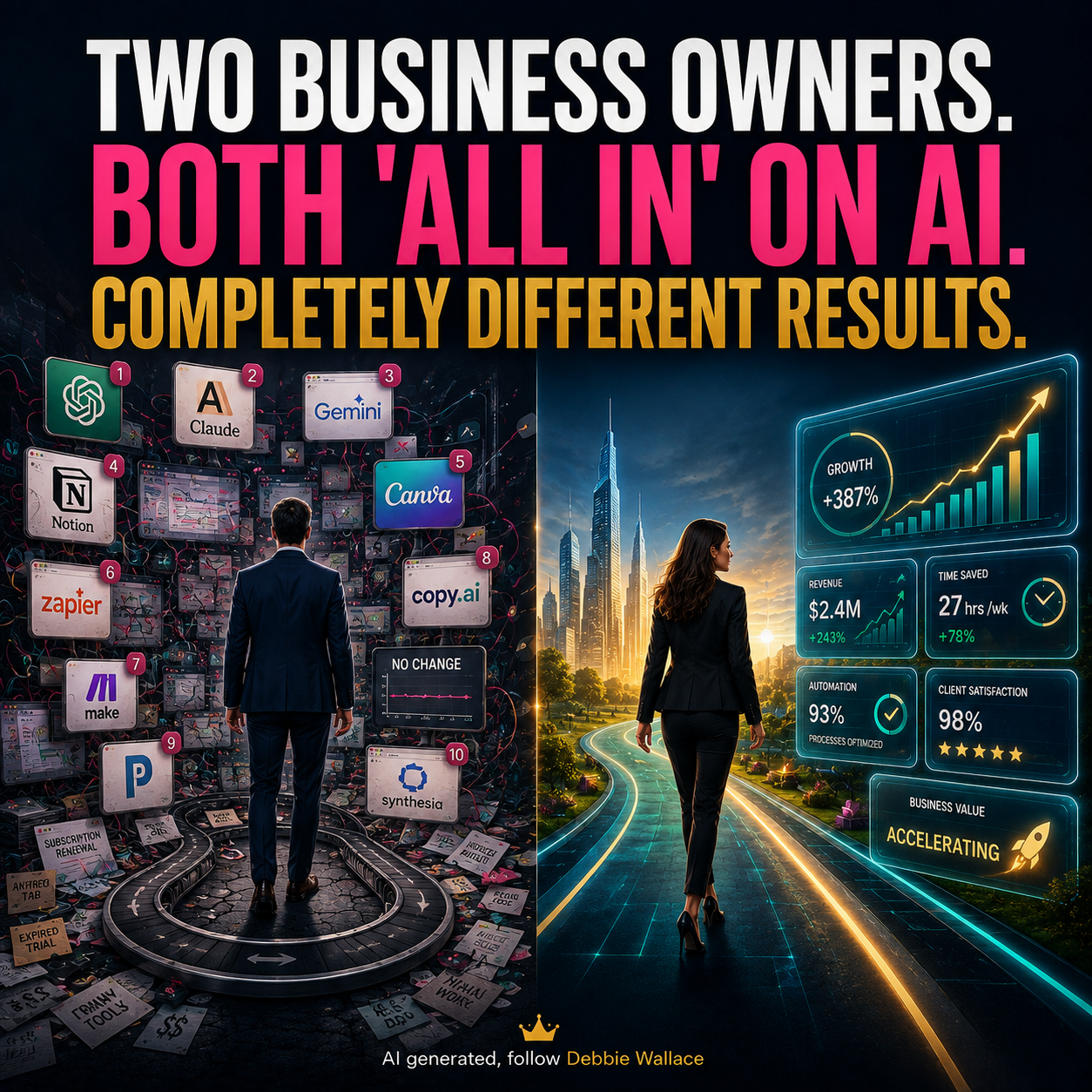
Two Business Owners. Both 'Going All In On AI.' Completely Different Results.
Reviewed by Debbie Wallace, Founder of aiBizAssist
Let me tell you about Robert. He ran a digital marketing agency. Fifteen staff, around £2 million a year in revenue, a solid business by any measure. He came to me buzzing with excitement. He was, in his own words, 'going all in on AI.' I smiled. I had heard that phrase before.
Here is what 'going all in' looked like in practice. Robert had signed up for ten different AI tools. His content team was using ChatGPT to write first drafts of blog posts and social captions. His designers were using Midjourney for image concepts. He had connected a Zapier automation to handle lead notifications. He had just bought an AI meeting notes subscription. And he was personally using Claude to brainstorm strategy ideas.
Four months in, I asked him a simple question. What had actually changed in terms of business results?
He was honest with me, which I respected. Revenue was roughly the same. Margins had actually dipped slightly because of all the new subscriptions. His team was spending a lot of time learning new tools and not noticeably less time doing the actual work. The content was coming out faster but converting at the same rate. The automation was saving maybe an hour a day across the whole team.
Robert had done what most business owners do. He had taken his existing business, the same team, the same offer, the same delivery model, the same workflows, and sprinkled AI on top of it. He was a retrofitter. And he could not understand why nothing had transformed.
Now Let Me Tell You About Jessica
Similar business. Digital marketing agency. Twelve staff, about £2.5 million in revenue. Jessica came to me around the same time as Robert. But Jessica did not start by buying tools. She started by asking a question that Robert never thought to ask.
'If I were starting this agency today, knowing what AI can do, would it look anything like this?'
The answer, when she sat with it honestly, was no. She would not have the team structured the way it was. She would not deliver her services the way she was delivering them. She would not price the way she priced. She would not have the client onboarding process she had built over years. She would not have the reporting workflow that her team ran every month. Almost none of it would survive a clean-sheet redesign.
So Jessica did something uncomfortable. She did not bolt AI onto her business. She sat down and rebuilt it around what AI made possible.
She Started With the Core Offer
Her agency had been selling monthly retainers for social media management, content creation, and paid ads. Fairly standard. Delivery was labour-intensive. Her team was producing content by hand, managing ad accounts manually, and generating reports in spreadsheets every single month.
She redesigned the offer entirely. Instead of selling hours of human labour dressed up as a retainer, she built a productised service where AI handled the first 80% of content creation, ad creative generation, and reporting. Her team's job shifted from production to quality control, strategy, and client communication. The same output, actually better output, delivered with roughly 40% of the labour hours.
That meant she had a choice. She could keep the same team and take on twice as many clients. Or she could serve the same number of clients with a smaller, better-paid team and significantly stronger margins. She chose the second. She reduced her team from twelve to seven, raised salaries for the people who stayed, and her margins moved from around 21% to 44%.
Then She Redesigned Onboarding
Previously it took two to three weeks. Calls, brand asset gathering, voice development, template building. She replaced it with a structured intake process that fed directly into a context library. The client completed a detailed brief, uploaded their existing materials, and Jessica's team used that foundation to build what I would call a permanent instruction set that the AI used for that client going forward. Onboarding dropped from two weeks to three days.
Then She Tackled Reporting
Instead of someone on her team spending hours pulling data from ad platforms, formatting slides, and writing summaries, she connected her ad accounts to an AI-driven analytics layer. Reports generated automatically. Her team reviewed them, added strategic commentary, and sent them. What used to take eight hours per client per month now took about ninety minutes.
I could keep going. But you get the picture. Jessica did not add AI to her business. She rebuilt her business around what AI made possible. Her agency today looks nothing like it did eighteen months ago. Same market. Same clients. Completely different company underneath.
Robert, by the way, is still running roughly the same business. A bit faster at a few things. His team uses AI tools every day. But his margins have not moved, his capacity has not changed, and his competitors are starting to eat his lunch. Because some of those competitors did exactly what Jessica did.
So Which One Are You?
Most business owners I speak to are Roberts. Not because they are not smart or not motivated, but because nobody has shown them the difference between using AI and redesigning for AI. Those are two entirely different things, and they produce entirely different results.
The retrofitters add tools. The architects rebuild systems. Both use AI every day. Only one of them is building something that compounds.
The question worth sitting with is not 'which AI tools should I be using?' It is 'if I were building this business from scratch today, knowing what AI can do, would it look anything like this?'
If the honest answer is no, that is not a problem. That is an opportunity. And it is exactly the kind of conversation I have with business owners every week.
If you are ready to stop retrofitting and start redesigning, I would love to talk. You can reach me at info@aibizassist.co.uk or visit aibizassist.co.uk to find out how we work together.
The businesses that thrive in the next five years will not be the ones that used the most AI tools. They will be the ones that asked the better question first.
Debbie Wallace is an AI business strategist and founder of aiBizAssist, helping UK business owners use AI practically and profitably.
Frequently Asked Questions
Ready to Stop Retrofitting?
Let's look at your business the way Jessica looked at hers, and find the redesign that actually moves your margins.