
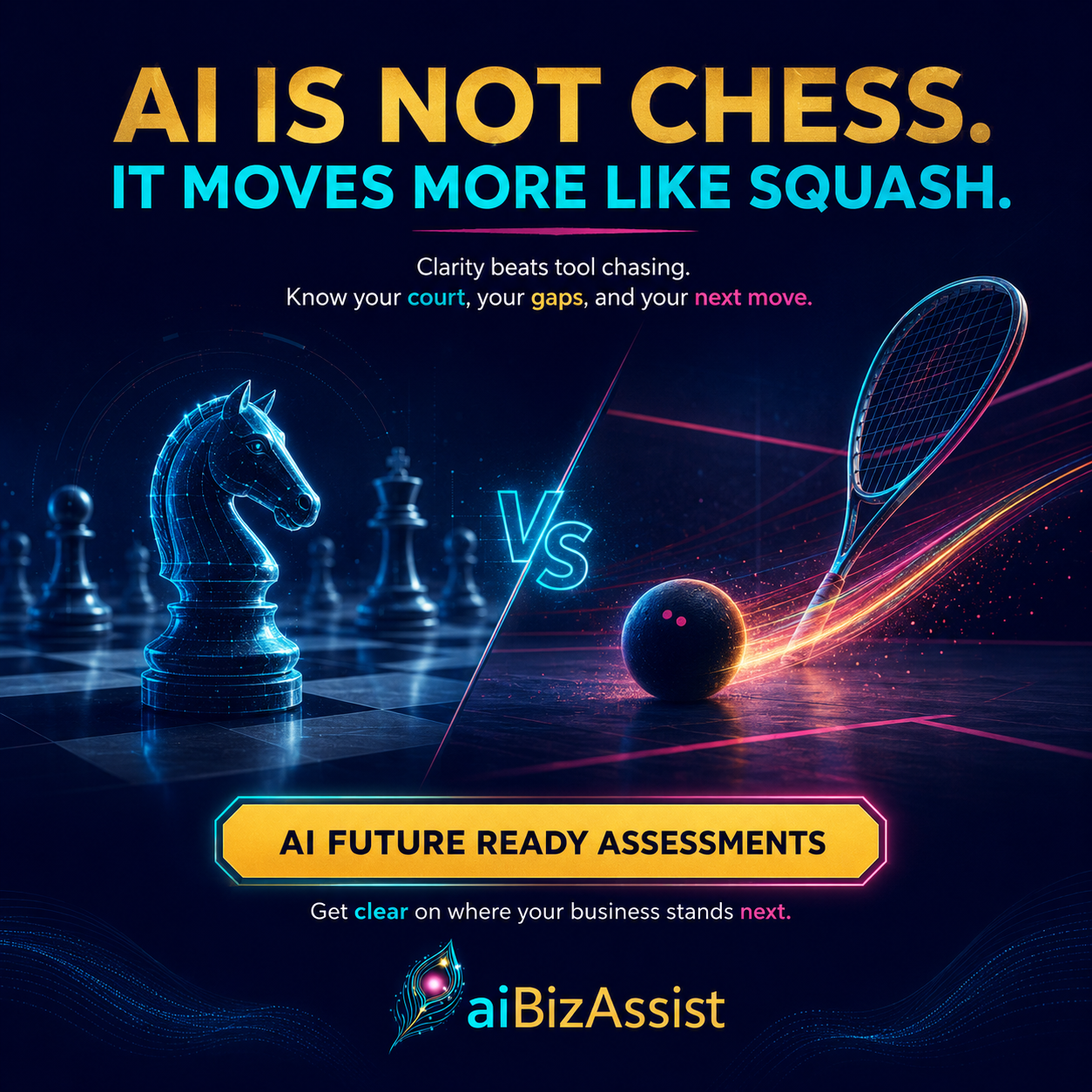
AI Is Not Chess. It Moves More Like Squash.
Reviewed by Debbie Wallace, Founder of aiBizAssist
A lot of businesses are still approaching AI like it's a chess game.
Considered moves. Careful planning. Study the board and wait for the right moment.
The problem is, nobody told AI to sit still.
Because right now, it plays more like squash. The ball is moving fast, the court keeps shifting, and the moment you plant your feet and admire your last shot, you've already lost the next point. New models, new capabilities, new use cases arriving before the last ones have even been properly understood. What felt cutting-edge in January is table stakes by March. The businesses treating AI as something to observe from a distance are finding that distance growing faster than they expected.
But the answer isn't to chase every ball either.
The best squash players aren't just fast. They know their court. They understand it well enough to anticipate where the ball is going before it gets there, which means they're rarely scrambling and almost never caught in the wrong position. They move with purpose, not just speed.
Clarity Beats Tool Chasing
That's exactly the kind of clarity that's missing for most businesses right now.
There's a real temptation to chase whatever is newest. Every week brings another tool launched with enormous fanfare, another capability that promises to change everything, another platform claiming to be the one your business cannot afford to miss. The shiny object problem in AI is expensive and exhausting, and plenty of companies have already burned through time, budget and goodwill trying to keep up with it all.
Moving fast without knowing your court is just expensive confusion.
What actually creates value is something far less exciting to talk about but far more useful in practice. Knowing where your business is today. Understanding where AI is genuinely heading. And being clear about what the gap between those two things means for you specifically. Not in the abstract. Not based on what worked for someone else. For your workflows, your team, your customers, your margins.
That's what separates businesses building something durable with AI from those who are experimenting indefinitely and wondering why nothing is sticking.
Why do I carry out AI Future Assessments?
It's also exactly why I carry out AI future assessments.
Not to hand businesses a list of tools to try or tell them what's trending this month. The goal is to give leaders an honest, grounded picture of where they stand today, where AI capability is realistically heading over the next twelve to eighteen months, and what that means in practical terms. Where the genuine opportunities are. What foundations need to be in place before those opportunities can actually be captured. And what to deprioritise entirely.
The output isn't a report that sits in a drawer. It's clarity. A clear position on the court, a clear direction, and a much shorter list of things that actually matter.
Because in a game moving this fast, the biggest risk isn't missing a tool.
It's not knowing where you are, where you're going, or why.
If AI feels more like noise than progress right now, that's usually a signal worth paying attention to.
An AI future assessment might be exactly where to start.
Frequently Asked Questions
Ready for an AI Future Assessment?
Get clear on where your business stands, where it's going, and what to do next.