
AI & Jobs: Not the Full Story - What the Research Actually Says
Reviewed by Debbie Wallace, Founder of aiBizAssist
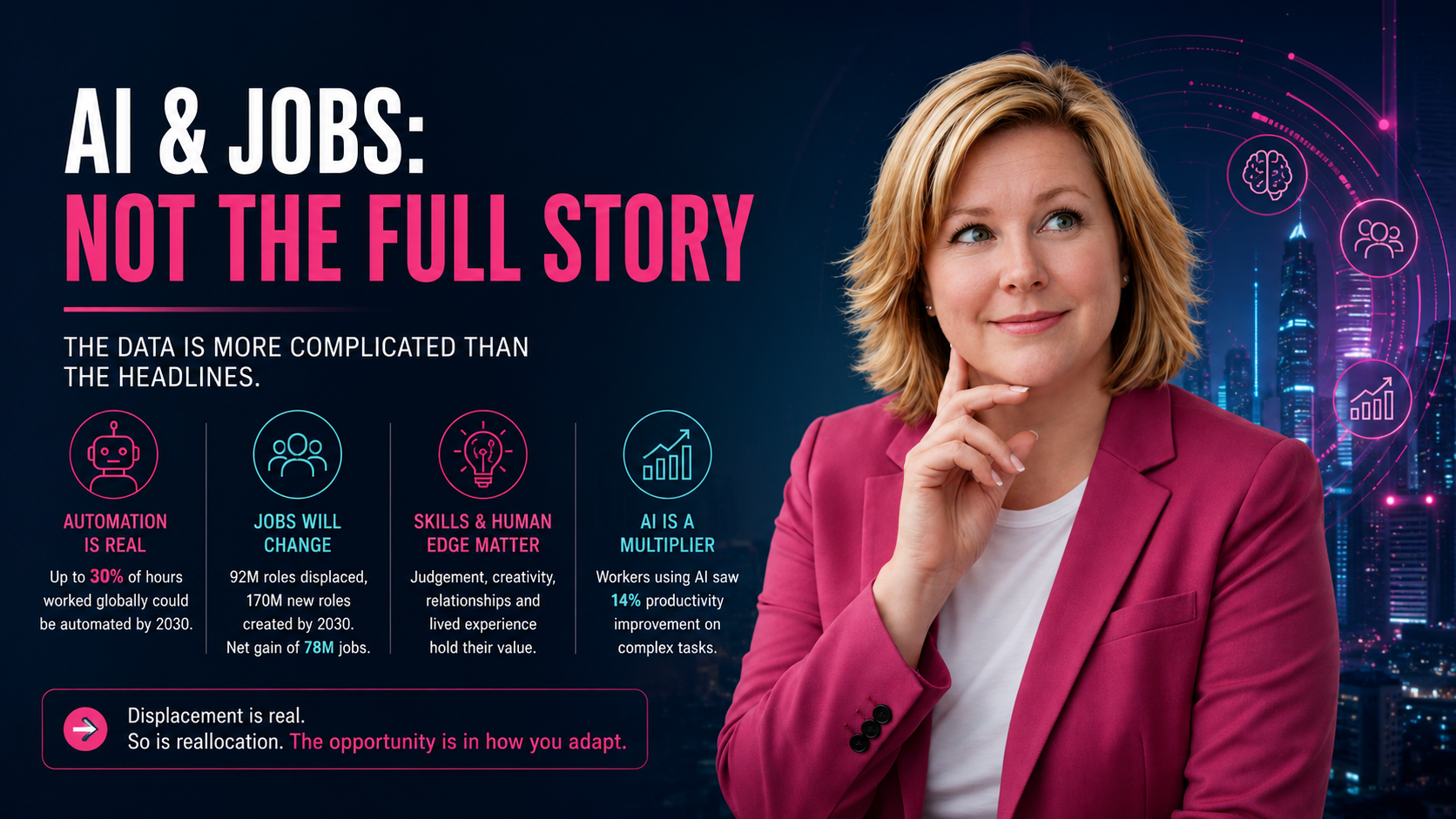
The headlines about AI and jobs are not wrong. But they are telling half the story. McKinsey's Global Institute estimates that up to 30% of hours worked globally could be automated by 2030, and that as many as 375 million workers may need to switch occupational categories entirely. Goldman Sachs puts it more starkly: AI could affect 300 million full-time jobs and automate roughly 25% of all work tasks across the US and Europe. These are not fringe predictions. They come from some of the most rigorous economic research institutions in the world.
The Same Researchers Are Telling a More Complicated Story
And yet those same researchers are telling a more complicated story than most people are sharing. The World Economic Forum's Future of Jobs Report projects that while 92 million roles will be displaced by 2030, 170 million new ones will be created, a net gain of 78 million jobs globally. McKinsey's own modelling shows that historically, technology has eliminated certain tasks while expanding the overall volume of work available. The pattern is consistent across every major technological shift of the last two centuries.
What Changes Is Not the Quantity of Work. It Is the Kind.
MIT economist Daron Acemoglu's research found that each robot added per 1,000 workers reduces employment by around 0.2% and wages by 0.42% in directly affected roles. But Acemoglu also found that these losses concentrated in specific, repetitive task categories, while demand grew in roles requiring judgement, relationship management, and creative problem solving. The displacement is real. So is the reallocation.
We Have Watched This Play Out Already
We have watched this play out in our lifetimes already. When YouTube scaled, Hollywood shed jobs. At the same time, between 500,000 and 600,000 creator economy roles appeared that had not previously existed. They did not look like the jobs they replaced. They paid differently. They rewarded different skills. But they were there for the people who moved towards them.
The Trades Offer Another Data Point Worth Sitting With
The trades offer another data point worth sitting with. Whilst knowledge work expanded over the past 25 years, fewer young people entered skilled trades. The result: a shortage of plumbers, electricians, and construction specialists that has pushed their earnings well above many graduate salaries in major UK cities. Supply dropped. Demand held. Income rose. The market corrected without anyone planning it to.
AI Is a Capability Multiplier, Not Just a Replacement Mechanism
MIT's productivity research adds a further dimension. A study by Brynjolfsson and colleagues found that workers using AI assistance saw a 14% improvement in productivity on complex tasks, with the largest gains going to lower-skilled workers who used AI to close the gap with their more experienced colleagues. AI is not simply a replacement mechanism. It is also a capability multiplier, and the people who learn to use it well will pull ahead of those who do not, regardless of their starting point.
The Jobs Most at Risk Are Built Around Repetition
What the research consistently points to is this: the jobs and businesses most at risk are those built around repetitive, predictable tasks with limited human judgement involved. The roles and ventures that hold their value are those built around problem identification, trust, lived experience, and the kind of contextual reasoning that still does not transfer well to a model.
This Is a Reallocation, Not a Removal
That is not a reason for complacency. McKinsey is clear that the transition will require real skill development and real adaptability. But it is a reason to look at this moment as a reallocation rather than a removal. The question is not whether your industry will be affected. The research suggests it will. The more useful question is where you are positioning yourself within that shift, and whether you are building the kind of skills and visibility that hold value regardless of what the next model release brings.
The data is not as bleak as the headlines suggest. But it does reward people who pay attention to it.
Frequently Asked Questions
Want to Position Yourself for the Shift?
Let's look at where AI fits in your business and where your human skills give you the real advantage.