
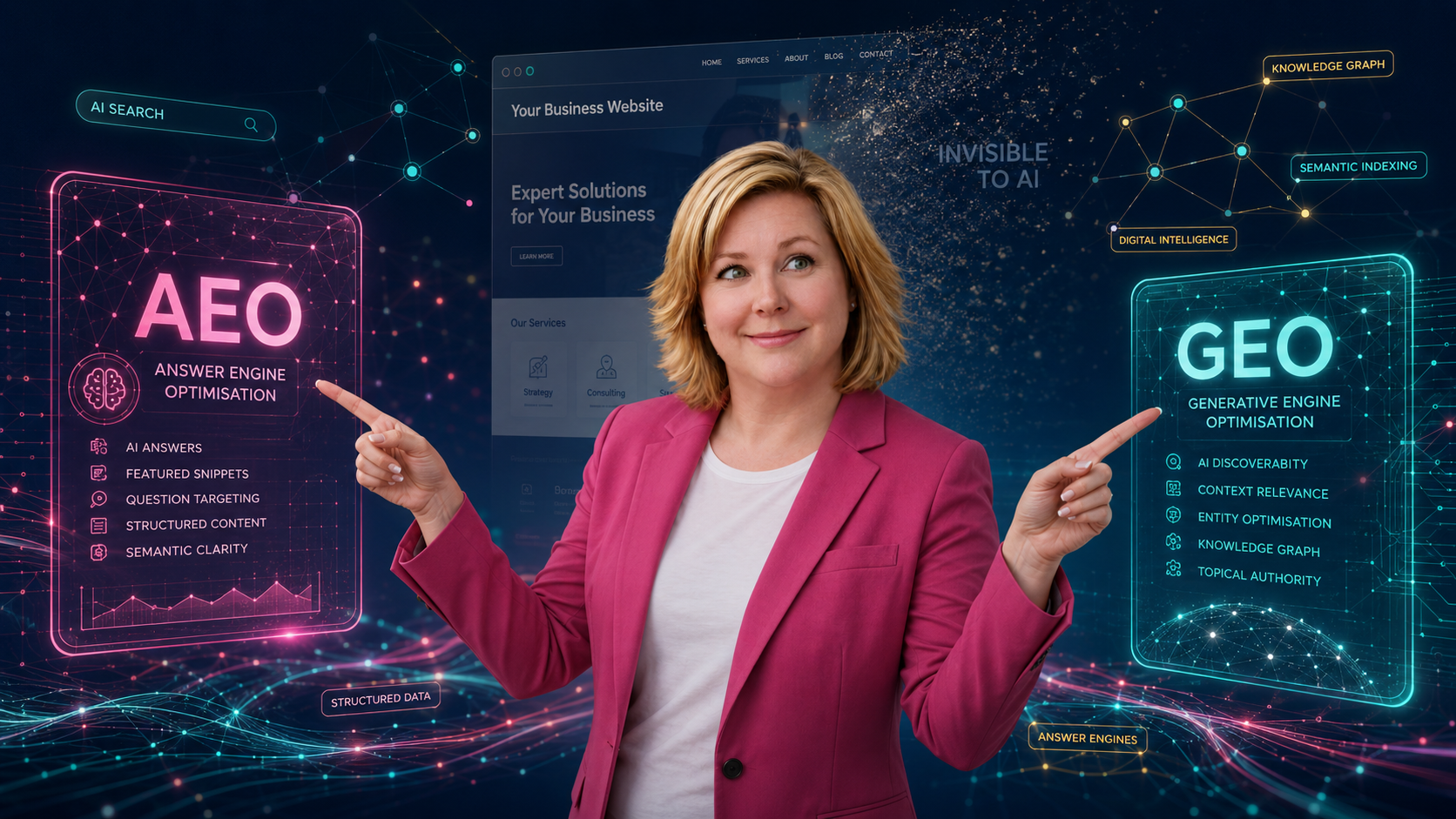
Why your website is invisible to AI: a real UK SME case study in AEO and GEO
Reviewed by Debbie Wallace, Founder of aiBizAssist
When a potential client asks ChatGPT, Perplexity or Google's AI Overviews to recommend an AI consultant for their small business, what decides whether your name comes up or someone else's does?
That question is what Answer Engine Optimisation (AEO) and Generative Engine Optimisation (GEO) are designed to answer. The gap between a website that AI tools cite and one they ignore is smaller than most business owners realise, but you need to know exactly where to look.
This article documents a real audit carried out on a UK SME consulting website: my own. Every issue described was found, and every one was fixed. If you run a small business website, there is a good chance you have at least half of these problems right now.
In short
The website looked professional to people but was close to invisible to AI tools. Every page sent crawlers the same title, there was no structured data, the blog posts could not be found, no sitemap had been submitted, and the business had almost no presence elsewhere on the web. Fixing the technical problems got every page discovered and indexed. The trust signals take longer to build.
What are AEO and GEO, and why do they matter for UK SMEs?
Traditional SEO helps search engines rank your website in a list of results. AEO and GEO go a step further: they help AI tools such as ChatGPT, Perplexity, Google's AI Overviews, Claude and Microsoft Copilot choose your business and cite your content when someone asks a question about what you do.
The difference matters because behaviour is changing. A growing number of UK business owners no longer type a query into Google and scroll through results. They ask an AI tool a direct question and act on the answer. If your website is not built in a way AI tools can read, understand and trust, you will not appear in those answers, however good your service is.
There is a technical catch. Google's crawler runs JavaScript, but most AI crawlers, including OpenAI's GPTBot, Anthropic's ClaudeBot and PerplexityBot, read only the raw HTML a page sends. If your page titles, content and structured data only appear after JavaScript runs, many AI tools simply do not see them.
The audit: what was found
The website was a UK AI consulting business. It was well written and clearly positioned, with good service descriptions and a blog. To a human visitor it looked professional and credible. To an AI crawler, it was almost entirely invisible.
Problem 1: every page sent crawlers the same title and description
Every page on the site (home, about, services, FAQs, blog and contact) sent the exact same title tag and meta description to any crawler that fetched it. The canonical URL on every page pointed back to the homepage.
This is a critical error. Search engines and AI crawlers use titles and descriptions to understand what each page is about. When every page looks identical, the site effectively has one page, the homepage, however much content is actually there.
It is a common problem on single page application (SPA) websites built with Lovable and other React-based builders, where page titles are set by JavaScript in the browser. Visitors see the right title. Crawlers reading the raw HTML see only the default.
What changed: every page now has its own title, description and canonical URL in the HTML the server sends, so crawlers can tell the pages apart without running JavaScript.
Problem 2: no structured data anywhere on the site
Structured data (schema.org markup) is the language AI tools use to understand what a website is about. It tells them not just what a page says but what it means: who the business is, who runs it, what services it offers, where it is based and which questions it answers.
The site had none. No LocalBusiness schema, no Person schema for the founder, no Service schema, no FAQPage schema, no Article schema on the blog posts and no breadcrumbs.
To an AI tool, that is like a library with no catalogue. The books exist, but there is no system for finding them.
What changed: structured data now describes the business, its founder, its services, its FAQs and every article, so AI tools can categorise the site correctly.
Problem 3: blog posts that crawlers could not find
The site had eleven blog posts written and published. None of them could be found by a crawler.
The blog page listed the posts using JavaScript, so a crawler fetching it received no links to them. The posts did not have their own addresses that a crawler could visit.
The result was eleven pieces of expert content that no search engine or AI tool could find, read or cite.
What changed: every post now has its own address, is linked from the blog page in plain HTML and is listed in the sitemap.
Problem 4: no sitemap submitted to Google Search Console
No sitemap had been submitted, so Google could only discover pages by following links, and most of those links were hidden behind JavaScript. Google Search Console showed very little indexing activity.
What changed: a sitemap was submitted and indexing was requested for the most important pages.
Problem 5: no external citations or recognition as a business
AI tools do not just read your website. They cross-check it against the rest of the web to decide whether you are a real, credible expert worth citing. That includes business directory listings, social profiles, mentions on other sites, review platforms and external publications.
The site had one external citation, a local business directory listing. There was no Trustpilot profile, no Google Business Profile and no external publication, and the founder's name did not appear in any indexed content outside the site itself.
To an AI tool, an expert with no footprint beyond their own website is an expert nobody has heard of. The technology to be cited was in place, but the trust signals needed to be chosen were not.
This is the slowest part to fix, because it depends on reviews, listings and mentions built up over time.
Why there is no one-size-fits-all checklist
The fixes fell into three areas: technical fixes so AI crawlers can read every page, content that answers the questions customers actually ask, and trust signals beyond the website such as a Google Business Profile, reviews, directory listings and LinkedIn.
Which of these matter most for another business, and in what order, depends on how its website is built, what it already has in place and who its customers are. A fix that was urgent here may not apply to your site at all, and your biggest gap may be one this site never had. That is what an AI visibility audit works out.
What AI tools look for when choosing who to cite
Understanding what AI tools look for helps you decide where to focus.
Expertise: does the content show genuine, specific knowledge? Generic content that could apply to any business scores poorly. Content that mentions specific industries, real numbers, named tools and first-hand experience scores well.
Authority: is the author a real, verifiable person with a consistent presence across trusted platforms? Named authorship, a LinkedIn profile, external publications and directory listings all help.
Trust: is the business real, locatable and reviewed? A Google Business Profile, reviews, and consistent name, address and phone details across every platform all signal trust.
Readability: can an AI tool understand what every page is about without running JavaScript? Page titles and descriptions in the HTML, structured data and a sitemap make this possible.
Most small business websites score well on expertise if the content is genuinely good. They score poorly on the other three, which is why they are not being cited.
The results
Once the technical fixes were in place, Google Search Console began discovering and indexing pages that had been invisible. The number of discovered pages went from zero to the full page count within 24 to 48 hours of submitting the sitemap.
Blog posts that no crawler could find became individually indexed pages, each one a chance to be cited when someone asks the question it answers.
Google's Rich Results Test began returning valid structured data, confirming that the site could be read and categorised correctly.
Search visibility builds over weeks. Appearing in AI-generated answers builds over months, as content and external trust signals grow. The technical foundation has to come first, because without it, good content alone is not enough to be cited.
The one thing most SMEs get wrong
The most common mistake is treating AEO and GEO as advanced marketing to think about later, once the website is established.
They are not advanced. They are foundational. Every week without readable pages, structured data and a submitted sitemap is a week in which AI tools build their picture of your industry without you in it.
Competitors who make these changes now build up citation authority while you are still deciding whether to prioritise it. The gap compounds over time, in the same way poor data compounds in an AI system: quietly and invisibly, until the consequences are hard to reverse.
The good news is that for most small business websites, the technical fixes can be done in days once you know exactly what needs fixing. Content and authority take longer to build, but they start working as soon as the foundations are in place.
Debbie Wallace is the founder of aiBizAssist and an AI Readiness and Business Process Consultant with 25+ years of experience in operations, supply chain and procurement. She helps UK SME owners adopt AI practically and safely, starting with workflow clarity before any technology. The AEO and GEO work described in this article was carried out on the aiBizAssist website itself.
Frequently Asked Questions
Want to know how AI tools see your business? An AI visibility audit checks your website and online presence and gives you a prioritised fix list.
Find out about AI visibility auditsBook Your Free Discovery Call
Want your website to be cited by AI engines? Let's talk about making your business visible where the next generation of customers is searching.